dqpack@danqing.net
 +8618125839585


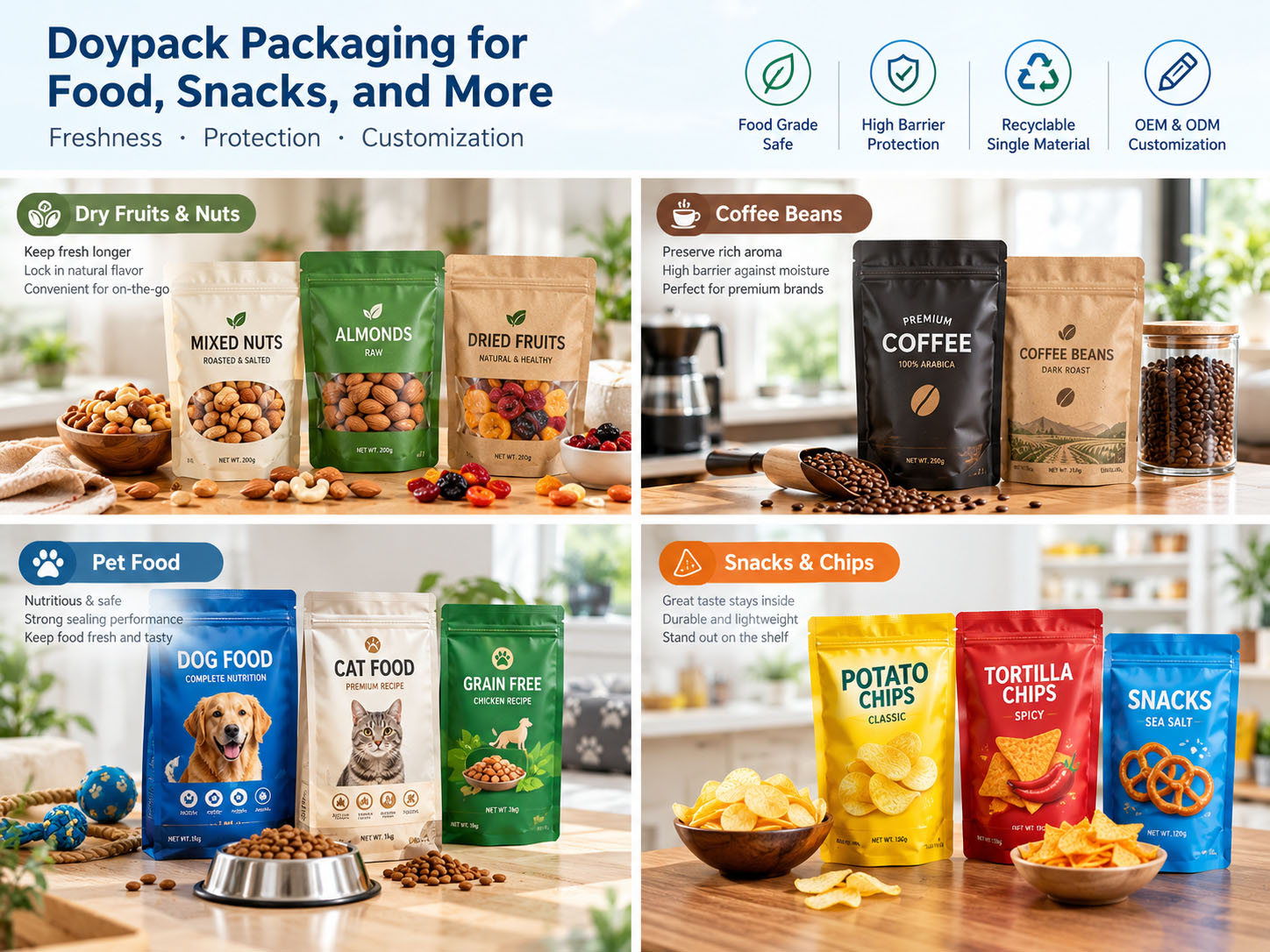
When selecting custom stand-up pouches, the step most often overlooked is “first figuring out what your product is vulnerable to.” Coffee is sensitive to oxygen and aroma loss; potato chips are prone to becoming soggy from moisture; pet food is susceptible to fat oxidation and insufficient load-bearing capacity; and dried fruits are prone to softening from moisture. Even with the same pouch style, a slight difference in material structure or sealing configuration can result in a shelf life that’s several months shorter. Below, I’ll break this down by product category, focusing on materials, bag styles, and key procurement considerations for each.
1. Why Different Products Require Different Stand-Up Pouch Packaging
The logic behind selecting a stand-up pouch essentially involves keeping the things a product fears most out while ensuring the bag functions properly during actual use. This primarily depends on four factors:
Sensitivity to Moisture and Oxygen: Dry foods (potato chips, nuts, coffee beans) are most sensitive to moisture and oxygen; if the wrong barrier layer is chosen, crispness or flavor will deteriorate significantly during the shelf life. Aroma Retention and Oil Resistance: Coffee and oil-containing products require materials that can lock in aroma molecules, while the inner layer must resist oil penetration; otherwise, the seal is likely to fail. Product Weight and Bag Strength: Snack bags weighing less than 500g and pet food bags weighing more than 5kg have completely different requirements for bottom seal strength and zipper tensile strength. Resealability and Ease of Use: Products that aren’t consumed in a single sitting require a zipper; for bags that are opened and closed frequently, choose a zipper with more durable teeth rather than the cheapest, generic option.
2. How to Choose Custom Stand-Up Pouches for Different Products
Coffee Bean Bags
Packaging Requirements: Retain aroma and block the entry of oxygen and moisture. Freshly roasted beans continue to release carbon dioxide; if the seal is too tight, the bag may bulge.
Material Selection: Depending on the coffee type and desired shelf life, PET/VMPET/PE is a common configuration that provides adequate oxygen barrier properties at a manageable cost; for higher flavor retention requirements or longer shelf lives, opt for a PET/AL/PE structure containing aluminum foil. Lightly roasted beans produce minimal carbon dioxide, so a valve may be omitted; for medium to dark roasts, a one-way vent valve is recommended to allow carbon dioxide to escape while preventing oxygen from entering.
Bag Type and Sealing: Stand-up pouches with a zipper are the standard configuration. The position of the vent valve must be confirmed during prototyping to avoid interfering with the printed area or the sealing line.
Purchasing Confirmation: Verify that the valve’s opening pressure matches the roast level; ensure the bag capacity aligns with the actual weight of coffee beans; and confirm that the seal strength can withstand stacking during transportation.
Snack and Potato Chip Bags
Packaging Requirements: The key is to protect against moisture to maintain crispness while slowing down fat oxidation. Once potato chips absorb moisture, their texture deteriorates much faster than many people realize.
Material Selection: PET/VMPET/PE are the most common choices for snack packaging. The metallized layer provides sufficient oxygen and moisture barrier properties, is less expensive than pure aluminum foil, and offers good print quality. For products with short shelf lives and fast turnover, PET/PE can also be used.
Bag Style and Sealing: Stand-up pouches with a zipper allow for easy resealing after opening. For fragile products (such as potato chips), pay attention to bag size and protection after filling; if the bag is too large, the product will have too much room to shift during transport, increasing the breakage rate.
Purchasing Considerations: Verify the actual volume after filling (not the flat-lay dimensions), the bag’s stability when standing upright, and whether the heat-sealing parameters are compatible with your filling equipment.
Pet Food and Treat Bags
Packaging Requirements: Products with higher fat content require special attention to prevent fat oxidation while controlling odor leakage. Larger-sized packages must also address the bag’s load-bearing capacity and withstand repeated opening and closing during daily use.
Material Selection: Depending on fat content and shelf life, PET, VMPET, PE, or EVOH-containing structures can all be considered. For applications with high odor control requirements, an aluminum foil structure is more reliable.
Bag Style and Sealing: A zipper is sufficient for small snack bags; for large bags weighing 1 kg or more, prioritize confirming the strength of the bottom seal and the tensile strength of the zipper. Standard single-track zippers are prone to tooth disengagement after repeated opening and closing, so consider a more durable tooth design.
Purchasing Confirmation: Packaging weight, filling method (manual or automated line), and whether drop test or transport test reports are required.
Dried Fruit and Nut Bags
Packaging Requirements: Moisture control is the top priority. In mixed nut and dried fruit blends, moisture from the dried fruits can migrate to the nuts; once nuts absorb moisture, they lose their crunch, so barrier requirements are often higher than for single-nut products.
Material Selection: For moisture-sensitive products or those requiring a long shelf life, a PET/AL/PE structure containing aluminum foil is the most reliable. For products with controllable storage conditions and fast turnover, PET/VMPET/PE is sufficient.
Bag Type and Sealing: Stand-up pouch with a zipper. If you need to showcase the product itself, consider a transparent window design; however, adding a window will reduce the barrier area. Be sure to confirm with the manufacturer how the window’s location and size will affect overall barrier performance.
Purchasing Confirmation: Product moisture content, target shelf life, and whether light protection is required (aluminum foil structures provide natural light protection, while metallized structures offer partial light protection).
3. How to Determine Materials, Dimensions, and Sealing Methods
| Customization Options | Key Considerations |
| Material Structure | PET/PE: Basic moisture barrier; PET/VMPET/PE: Moderate barrier properties, high cost-effectiveness; PET/AL/PE: Highest barrier properties, suitable for flavor-sensitive and long-shelf-life products |
| Bag Size | Determined by reverse calculation based on product weight and bulk density, not estimated by flat-lay dimensions. Powders and granules have the same weight but significantly |
| Sealing Configuration | Select the zipper tooth type based on opening/closing frequency; tear notches reduce the difficulty of first-time opening; Determine the use of an exhaust valve based on whether the product generates gas |
| Surface Finish | Matte or glossy finishes affect shelf appeal but do not impact freshness retention; determine based on brand identity |
| Sealing Performance | Confirm that heat-sealing conditions are compatible with your filling equipment; discuss seal width and temperature parameters in advance |
4. What Information Is Required for Custom Stand-Up Pouches
Have the following information ready before requesting a quote so that the manufacturer can provide meaningful proposals and pricing:
Product type and net weight per pouch (e.g., medium-dark roast coffee beans, 250g/pouch)
Pouch dimensions or existing packaging samples (physical samples are preferred; if unavailable, provide the weight and product shape)
Target market and expected shelf life (e.g., domestic e-commerce, 6 months)
Material, barrier properties, and sealing requirements (if you have specific preferences; otherwise, the manufacturer can make recommendations)
Status of the print design and estimated initial order quantity (whether the design is finalized; the estimated quantity affects the minimum order quantity and unit price)
Filling method and special testing requirements (automatic filling line or manual bagging; whether drop testing is required)
5. Why Choose a Custom Stand-Up Pouch Manufacturer
The difference between custom pouches and off-the-shelf pouches lies not in “whether a logo can be printed,” but in whether the material structure matches your product, whether the sealing configuration can withstand actual use, and whether quality remains consistent during mass production. At DQ PACK, we offer the following services: discussing material structures based on product characteristics (ranging from PET/PE to high-barrier configurations containing aluminum foil), customizing bag styles and dimensions, matching accessories such as zippers and valves, and providing end-to-end process support from design approval through prototyping to mass production delivery. In actual production, print accuracy, lamination strength, and seal consistency are several key control points that determine whether a bag is functional; these must be confirmed during the prototyping stage.
6. Frequently Asked Questions
Q: What is the best material for custom coffee stand-up pouches?
A: There is no “best” option—only the “best fit.” The standard choice is PET/VMPET/PE; for applications requiring high flavor retention or a long shelf life, PET/AL/PE is a safer bet. For freshly roasted beans, consider adding a one-way vent valve.
Q: Are custom stand-up pouches suitable for pet food and treats?
A: Yes, they are suitable. The key is to select the material structure based on fat content and bag weight. For large-size packaging, verify the bottom seal’s load-bearing capacity and the zipper’s durability; standard snack bag configurations cannot be used directly.
Q: Can stand-up pouches be equipped with zippers and one-way valves?
A: Yes. Zippers and one-way valves are standard optional features, but the valve position and zipper tooth type must be confirmed based on the product and usage scenario—they cannot simply be added arbitrarily.
Q: How do I choose the size of a stand-up pouch?
A: Calculate the capacity based on the product’s weight in grams and bulk density, then determine the size by considering shelf display requirements and filling equipment limitations. The most reliable method is to test with actual product in sample pouches—a pouch that looks good when laid flat may not be suitable once filled.
Q: What information is needed for a quote on custom stand-up pouches?
A: Product type, weight per pouch, pouch dimensions or a sample, target shelf life, material preferences (if any), print file status, and estimated quantity. If you have specific filling methods or testing requirements, please include them as well—this will help us provide a more accurate quote.
Post time: Oct-27-2026